
Is 50 the new 30? Media impact on old-age self-image in focus
The National Media and Infocommunications Authority (NMHH) and the ‘Altogether Now’ Foundation for Healthcare (FOEA) held a conference called “50 is the new 30?” in Budapest. It featured experts, researchers and public figures discussing the changing social perceptions of being in one’s fifties and the prospects of a long and healthy life, covering the role of the press and new media in shaping self-image and quality of life in older age.
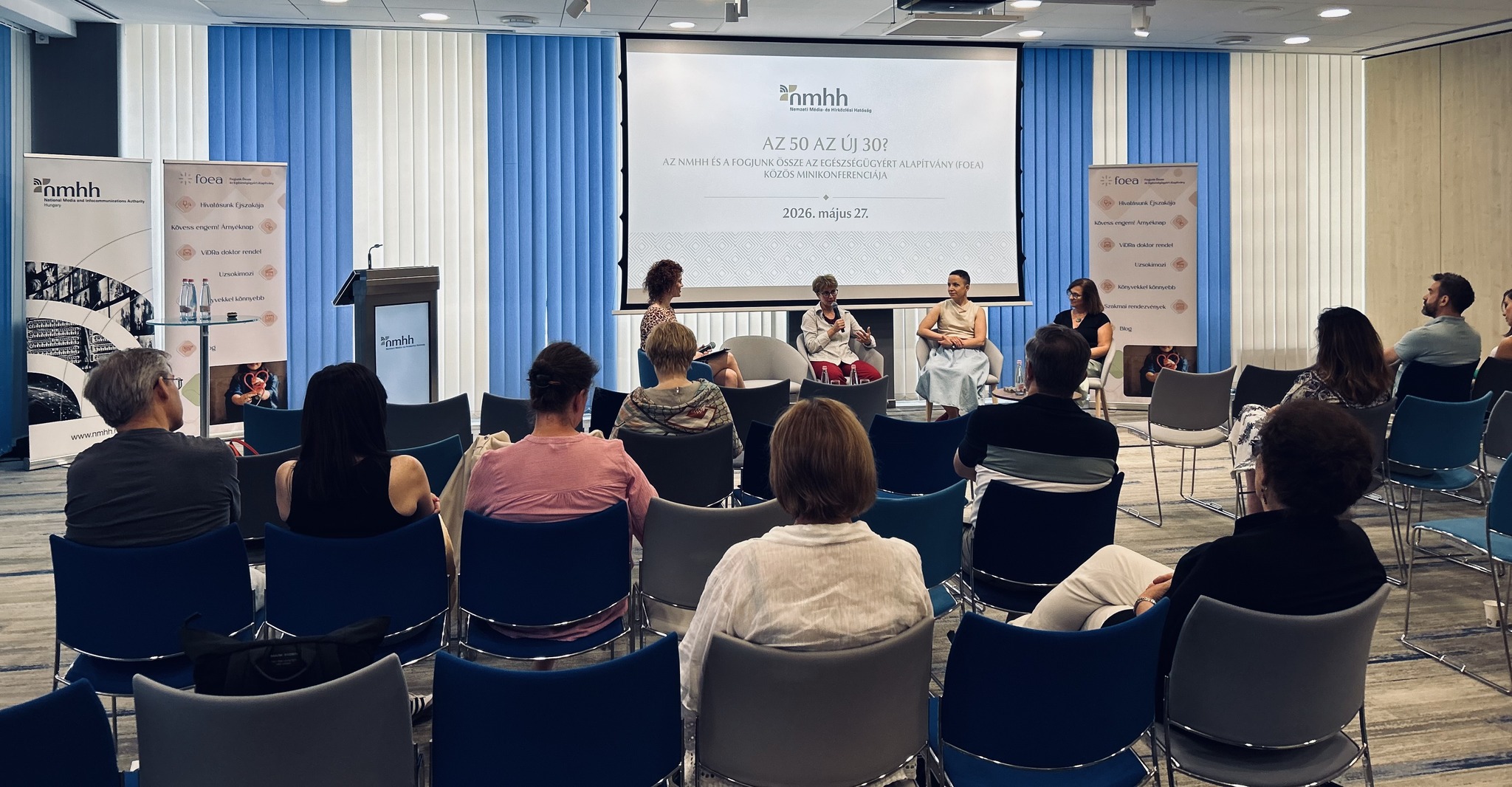
One of the priorities for the cooperation between the media authority and FOEA is to explore the common ground between health and media literacy, as pointed out by the NMHH’s Deputy Director for Media Market Cooperation and Research in his opening speech. István Galambos added that it is this common ground from which the experts from both institutions seek to provide useful advice for a longer, and also better-quality, life. The Deputy Director pointed out that the digital space is also very much concerned with the topic of longevity – a long a healthy life. Although there has not been any research into this issue, probably one of the most frequently asked questions for AI is “What is the secret to a long life?”. How linguistic models answer this question actually matters. “Can such answers have a motivating effect or are we mostly just curious but end up doing nothing about it?”, asked István Galambos in his opening speech.
The statement that 50 is the new 30 is very true in some ways, but we see quite the opposite from a different perspective, the President of FOEA said at the event. As Andrea Ficzere put it, middle-aged people today tend to take better care of their physical health, be more physically active and eat healthier than those in their fifties in previous decades; however, at the same time, they are often in a worse state of mental health than their age would warrant. The expert says the modern world both helps us live healthier and, in many ways, puts more strain on us than before.
In the first presentation of the professional programme, Zsófia Szentpáli, a cardiologist from the Hungarian Association of Preventive and Lifestyle Medicine, spoke about the fact that two people born in the same calendar year could have very different biological ages. The expert stressed that our biological age was greatly affected by our lifestyle, which could make it better or worse in a matter of months. It is also important to have a healthy diet, be physically active, learn the appropriate stress management techniques, have social interactions and get 7 to 8 hours of sleep a day, Zsófia Szentpáli pointed out. The cardiologist also recalled that the average lifespan of Hungarians today was 74 to 80 years, but they are considered healthy only until the age of 62 to 64, which is far from ideal.
The life of fifty-year-olds is characterised by many contradictions: they have a growing need for independence, while, at the same time, many of them may find themselves in a vulnerable situation in the labour market due to, for example, their deteriorating health, Ilona Kónya said at the event. The clinical psychologist also pointed out that empty nest syndrome often occurs at this age as children have mostly left the family home by then. Many middle-aged people are also affected by the ‘sandwich generation’ phenomenon where they have to support both their ageing parents and their growing children. While many people still form new relationships and friendships at this age, loneliness and isolation are common issues, particularly for those living in smaller communities.
In her presentation, the NMHH’s research expert offered a peek at the joint study by the authority and PSYMA, to be published in a few months, which mapped the health topics on which people most often get information from the media. One of the highlights of the results is that although health awareness is increasing in Hungarian society, the focus of interest remains on disease detection and treatment rather than long-term prevention. Zsófia Bodolay-Papp stressed that it is key to apply a critical filter to the flood of online content hitting us, as to its authenticity. The expert pointed out that around 500 hours of video are uploaded to YouTube every minute worldwide so it makes sense that experts are not the only ones sharing their views on social media on the issue of longevity.
One of the highlights of the conference was a roundtable discussion called “Filtered reality - distorted mirror or motivating force?” with plastic surgeon Anikó Horváth, photographer Benjamin Szabó, and founder of the Rebirth programme Andrea Kandász, moderated by Andrea Ficzere. The discussion covered the ethical limits of plastic surgery and the responsibility of physicians in assessing patients’ cosmetic needs. Participants agreed that it is essential for people who go to plastic surgeons to have a healthy self-image to be able to make responsible choices about their own bodies; however, this is getting increasingly distorted by filtered beauty ideals on social media.
Participants of the roundtable discussion called “Why do we want to stay young?”, including psychologist Éva Lázár-Cseke, literary historian Anna Gács and cardiologist Zsófia Szentpáli, discussed with assistant professor Eszter Nádasi how we should remain true to ourselves even in the pursuit of a youthful appearance as it can lead to chronic and severe anxiety.
In the event’s closing discussion moderated by literary editor Ágnes Orzóy, clinical psychologist Rita Oláh, author Judit Szlavicsek and sociologist/lawyer Fruzsina Gulya explored the opportunities in mid-life crisis. Among other things, the participants pointed out that loneliness among middle-aged people could easily be prevented by volunteering in a community or indulging in a hobby.
A key takeaway of the conference was that, besides individual choices, communities, institutions and the media have a significant role and responsibility in promoting healthy and active ageing. The NMHH and the FOEA will continue to pay particular attention to supporting initiatives that promote health and media literacy and intergenerational dialogue.
For the highlights of the conference, see the video below, available to be freely used and embedded: