
Three new schools join the NMHH Partner School Programme
The National Media and Infocommunications Authority (NMHH) presented awards to outstanding teachers at its partner schools for the second time. Thirty-three teachers received certificates of recognition for their exemplary work in developing media literacy among students at the Partner Schools Programme’s Friday conference and awards ceremony. Attendees also had the opportunity to learn about the latest findings of the NMHH Digital Parenting study, which were subsequently discussed by partner school educators and NMHH experts in an insightful roundtable discussion.
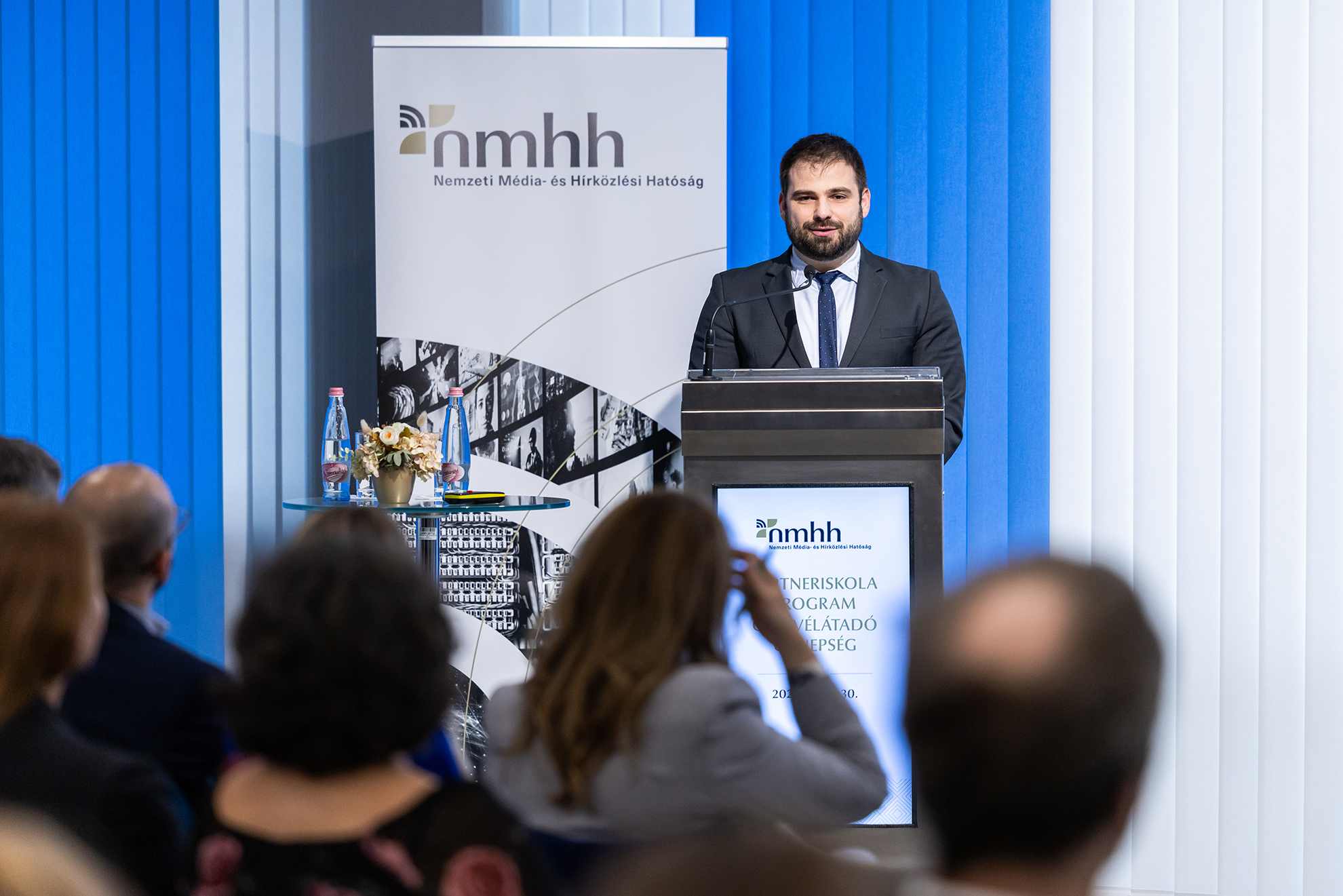
Ákos Somogyi, NMHH Head of the Department for Child Protection reported on the latest successes of the programme at the event: from Pécs, Nagy Lajos Secondary School and College of the Cistercian Order and Babits Mihály Secondary School both joined the Media Authority’s Partner School Programme, while from Tiszaújváros, Széchenyi István Elementary School has become a member. He stressed that the Partner School network brings together institutions that go above and beyond in preparing their students for the challenges of the digital space, as well as teachers who make exceptional efforts to support their students in developing their talents.
Ákos Somogyi added that, through the Partner School Programme, the NMHH aims to further encourage and support the existing good practices and media education goals of its partner institutions and their teachers. He stressed that cooperation is based on two-way knowledge sharing: the NMHH provides the teachers of partner schools with insight into its own media literacy teaching methods, and supports their work with professional background materials. At the same time the experts of the media authority also adopt good practices from the teachers, which they then try to disseminate to a wider audience.
Somogyi further emphasized that the Partner School Programme would not be successful without the conscientious and high-quality work of the teachers involved, who, among other things, fill the school media labs established with NMHH support with enthusiastic students, offering their pupils the opportunity for experience-based learning. He added that this is precisely why NMHH considered it of the utmost importance to once again recognise thirty-three outstanding teachers with certificates.
The event was followed by the NMHH’s Child Protection Analyst presenting the latest findings of the media authority’s Digital Parenting study on media use by 7–16 year olds. In her presentation, Alexandra Fóris pointed out that nearly one in three children today receive their first mobile phone from their parents at the same time as their school bag, which in many cases is not accompanied by adequate information and guidance from their parents or guardians. She stressed that children typically first register on social media platforms at the age of 11. She added that although the minimum registration age on these platforms is supposed to be 13, 80% of young people will already have such a profile by age 12, and practically all of them by age 15 at the latest. Unmonitored online presence greatly increases the risk of exposure to online dangers, underlined Alexandra Fóris.
After the presentation, Adrienn Novák, a legal officer for child protection at the NMHH, discussed the findings of the research with Árpád Varga, head of the NMHH media literacy department, Balázs Palkó, a teacher at the Vác Piarist Secondary School, and Péter Juhász, a teacher at the Evangelical Kossuth Lajos Secondary School in Nyíregyháza, in a thought-provoking round table discussion. Participants stressed that restriction, prohibition or constant monitoring are common strategies employed by parents, but that active mediation could be a more effective tool. They highlighted that prior and ongoing dialogue between parent and child, exploring the internet together and discussing risks and opportunities is one of the most effective tools for prevention. A summary of the NMHH’s recent Digital Parenting research (in Hungarian), as well as its detailed findings (also in Hungarian) are available on the authority’s website.
Following the round table discussion, the recognised educators of the NMHH’s partner schools received their certificates from department head Ákos Somogyi. During the remainder of the event, NMHH staff held valuable discussions with the attending teachers and the heads of the institutions present. Participants were able to share their practical experiences, observations and future plans on media literacy education – a dialogue aimed at supporting the development of professional programmes.
Heartfelt congratulations to all the award recipients for their outstanding achievements!