
Digital parenthood – a new book on the challenges of childhood in the digital world
The book “Digital Parenthood”, published in the Gondolat Kiadó Media Studies book series, also addresses “sharenting” in detail. This concept, a portmanteau of “sharing” and “parenting”, describes one of the most widespread yet most controversial phenomena of our time. Edited by media lawyer Gergely Ferenc Lendvai and András Koltay, President of the National Media and Infocommunications Authority (NMHH), this long-awaited work examines the opportunities, challenges and conflicts of digitalised childhood from various perspectives.
“Technological progress and, obviously, digitalisation, have greatly contributed to making childhood simultaneously more atomised and more diffuse. In the past, it took a whole village to raise a child; today it takes the entire internet,” reads the study on children’s rights, co-authored by Szilvia Gyurkó and Viktória Botos. Parents fumbling in confusion with electronic diaries, grandparents posting about their grandchildren, teachers dabbling as influencers – these are some of the typical aspects of digitalised childhood, highlighting how the Internet age has reshaped society as a whole, and how online reality has become an inescapable part of family life.
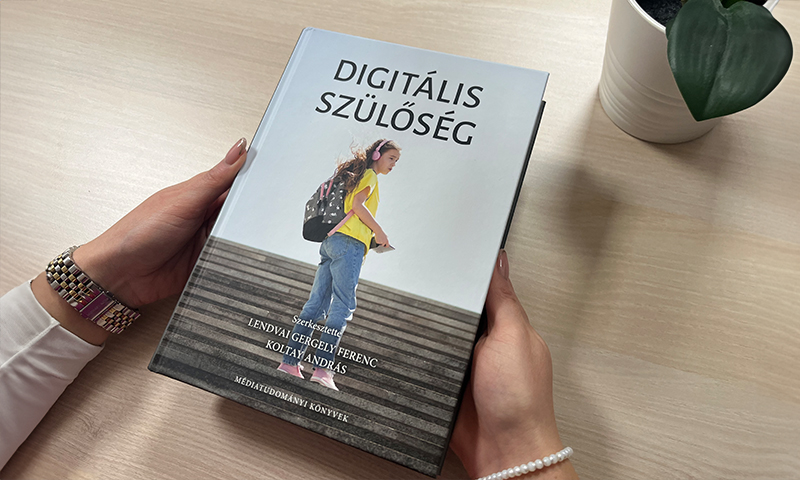
The essays in the first part of the book explore how and why parenting habits have changed alongside the proliferation of online platforms (social media, video-sharing platforms, etc.). For example, the issue of digital control is raised in response to key questions about digital parenthood, and readers can also gain insights into how applications using artificial intelligence can help disadvantaged groups catch up, and how these tools can be used in education.
The second part of the book explores regulatory issues relating to digital parenting, mainly from a privacy and data protection perspective, while also bringing family rituals and influencer marketing into focus. The fact that the book devotes several studies to the phenomenon of sharenting underscores the weight and significance of the topic, and explains why it has become a buzzword in the social sciences. One of the problems with sharenting – that is, parental (over)sharing – is that parents create and shape their child’s digital identity on social media. This can even result in a child becoming a public figure against their will, as a result of their family’s online activity. And when a parent posts about their child on their own profile page, they are intruding on their child’s private sphere. Even if that was not their intention, they are still violating the child’s right to privacy and digital autonomy. Another problem with parental posting is that content shared on social media can remain accessible for years or even decades.
The study by András Koltay and Gergely Ferenc Lendvai discusses the phenomenon of sharenting as a legal issue. They describe it as “more than a family ritual – it is a practice that shapes and transforms children’s digital identity, the online portrayal and perception of parental behaviour, and potentially also intra-family relationships.” They consider images posted on social media to be a form of expression, interpreting them through the lens of freedom of speech. They seek to answer the question: to what extent are such images protected by law, and whether – and when – this form of expression should be restricted. Drawing on examples from international case law, they shed light on who has standing to act in cases where there is a conflict between the interests of the parent and the child.
“Although there is a growing body of literature on the use of digital devices by children and parents, we felt it would be worthwhile to explore the topic from a variety of perspectives, with input from a number of different experts. The result was a book written in a scientifically rigorous, yet accessible language for all those who wish to delve deeper into the topic,” said co-editor András Koltay, President of the NMHH.
As children are more vulnerable to the dangers of the virtual world due to their youth and lack of life experience, the NMHH pays particular attention to their online safety. The Authority promotes safety in internet use – including social media – through a wide range of programmes, campaigns and publications. As part of this commitment, the richly referenced volume entitled Digital Parenthood was published at the end of 2025, and will serve as a valuable resource for interested readers and researchers alike.