
Experts do not recommend the therapeutic use of AI chatbots
It can be contacted at any time and always responds readily, but there are serious risks involved –this is how an AI chatbot can be described when used for therapeutic purposes. As more and more people seek psychological help from ChatGPT and its peers, renowned psychologists and social researchers raised awareness of the dangers and potential uses of ChatGPT on 28 April 2026, during the 15th Media Myths (Médiamítoszok) club discussion series organised by the National Media and Infocommunications Authority’s Institute for Media Studies.

“Every sixth young person turns to AI with a psychological question” – said Professor Dr Petra Aczél, Head of Research at the NMHH Institute for Media Studies, the host of the event. The fact that so many people around the world use chatbots to discuss psychological issues and share their psychological dilemmas points to a shortage of professionals and capacity, but also to deeper psychological processes. Annamária Tari, psychotherapist, psychoanalyst and clinical psychologist, explained that the infinite possibility of asking questions has an addictive effect. “The constant search for answers is a state that is very attractive because of its addictive nature,” explained an expert who has been researching the effects of digital media for decades.
In general, in surveys made with US teenagers, 70–75% of respondents praise AI chatbots for reinforcing their opinions, and for being ever-present, engaging and non-stigmatising. “Users can immediately read advice and tangible tips that they would not get in a therapy session right away,” said Dr Bálint Hajduska-Dér, psychiatrist, psychotherapist and assistant professor at the Department of Psychiatry and Psychotherapy at Semmelweis University. According to a mental health researcher, the immediate response of a chatbot may even include useful advice. “We can take out the features that are useful to us” – for example, the user may receive cognitive behavioural therapy or relaxation techniques, and also experience a continuity between sessions.
The benefits of a few practical advice, however, are dwarfed by the dangers of using AI for therapeutic purposes, according to all the participants in the roundtable discussion. “Deep spiritual issues are discussed in these conversations, which contain a lot of personal data,” said Dr Ágnes Veszelszki, Deputy Head of Research at the NMHH Institute for Media Studies, co-organizer and regular participant of the Media Myths events. Companies that operate chatbots not only have access to this personal, often intimate information, but may also use, and even sell it.
In addition, if you get answers to your questions immediately, you are not learning or practising the skill of “holding”. Annamária Tari explained that it causes emotional incontinence if someone is not able to develop their own strategies to deal with what has happened to them before sharing it with others. Social media already pushes us to share immediately what is difficult and requires processing, but with AI chatbots this pressure is only intensified. Indeed, many people may feel that they do not need human contact at all to process what has happened to them. “Is the kind of urge for sociability we really need disappearing?” – asked Annamária Tari. “Humans are basically social beings, and before turning to each other, now we turn to a machine. It does not look good if the 21st century is going to give us the idea that the easiest available solution is enough.”
Users become attached to AI applications because these are often endowed with human-like features. “We anthropomorphise the chatbot because it communicates in human language, and we falsely imagine it is being empathetic”, explained Ágnes Veszelszki. Many people give a name to their favourite chatbot, not realising that it is merely imitating empathy. There is no real emotion and physical experience behind it, and it lacks the kind of compassion you would expect from a therapist.
In the meantime, professionals are faced with the creation of a competition against which they are constantly compared. “It is a kind of relation that is always giving, while we often confront patients with their problems. This is a long and hard joint work, which AI cannot recreate, and this is what really makes a difference in therapy,” explained Bálint Hajduska-Dér. Annamária Tari added that the inclusion of an invisible third party in the therapeutic relationship can also increase patients’ narcissism. “Do not ask for advice from AI, ask for information and keep your distance,” summarised Petra Aczél the expert advice. “We should ask what I can do about anxiety, not why I am anxious,” added Bálint Hajduska-Dér.
“We should start by taking responsibility for our actions. We should not expect AI to solve them”, said Dr Nóra Kepe, social researcher and lecturer at Pázmány Péter Catholic University. She believes that at a societal level, the therapeutic use of AI may reinforce the pathologizing tendencies that have been increasingly present in society over the last few decades. She emphasized that “compared to the general worldview, we started to increasingly think about ourselves in psychological terms”. In everyday conversations, terms such as transgenerational trauma, anxious attachment or depression are often used, usually without deep understanding or misapplied.
If people focus more and more on their traumas, the AI will learn this attitude. “Are we on the road to forming a trauma society?” – posed the burning question Nóra Kepe. The chatbot reflects the user’s style, to please them and keep them on the platform as long as possible. A pre-patient is created during the use of AI: “If my assumption is that I have a problem, it will lead me in that direction,” explained Annamária Tari, who does not recommend the therapeutic use of AI at all under the age of 25. AI is therefore not only shaping the users who use it for therapeutic purposes, but also transforming professions and human connections – and the social impact is as yet unforeseen.
-
 dr. Veszelszki Ágnes, az NMHH Médiatudományi Intézet kutatásvezető-helyettese, dr. Kepe Nóra társadalomkutató, a Pázmány Péter Katolikus Egyetem óraadó oktatója és dr. Hajduska-Dér Bálint pszichiáter, pszichoterapeuta
-
 Sokan voltak kíváncsiak a Médiamítoszok klubbeszélgetés-sorozat 15. alkalmára
-
 dr. Hajduska-Dér Bálint pszichiáter, pszichoterapeuta, a Semmelweis Egyetem Pszichiátriai és Pszichoterápiás Klinikájának egyetemi tanársegédje
-
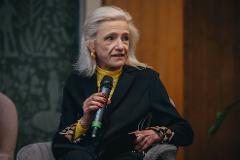 prof. dr. Aczél Petra, az NMHH Médiatudományi Intézet kutatásvezetője
-
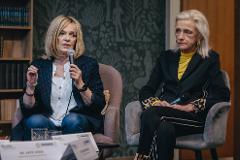 Tari Annamária pszichoterapeuta, pszichoanalitikus, klinikai szakpszichológus és prof. dr. Aczél Petra, az esemény házigazdája
 dr. Veszelszki Ágnes, az NMHH Médiatudományi Intézet kutatásvezető-helyettese, dr. Kepe Nóra társadalomkutató, a Pázmány Péter Katolikus Egyetem óraadó oktatója és dr. Hajduska-Dér Bálint pszichiáter, pszichoterapeuta
 dr. Hajduska-Dér Bálint pszichiáter, pszichoterapeuta, a Semmelweis Egyetem Pszichiátriai és Pszichoterápiás Klinikájának egyetemi tanársegédje
 prof. dr. Aczél Petra, az NMHH Médiatudományi Intézet kutatásvezetője
 Tari Annamária pszichoterapeuta, pszichoanalitikus, klinikai szakpszichológus és prof. dr. Aczél Petra, az esemény házigazdája