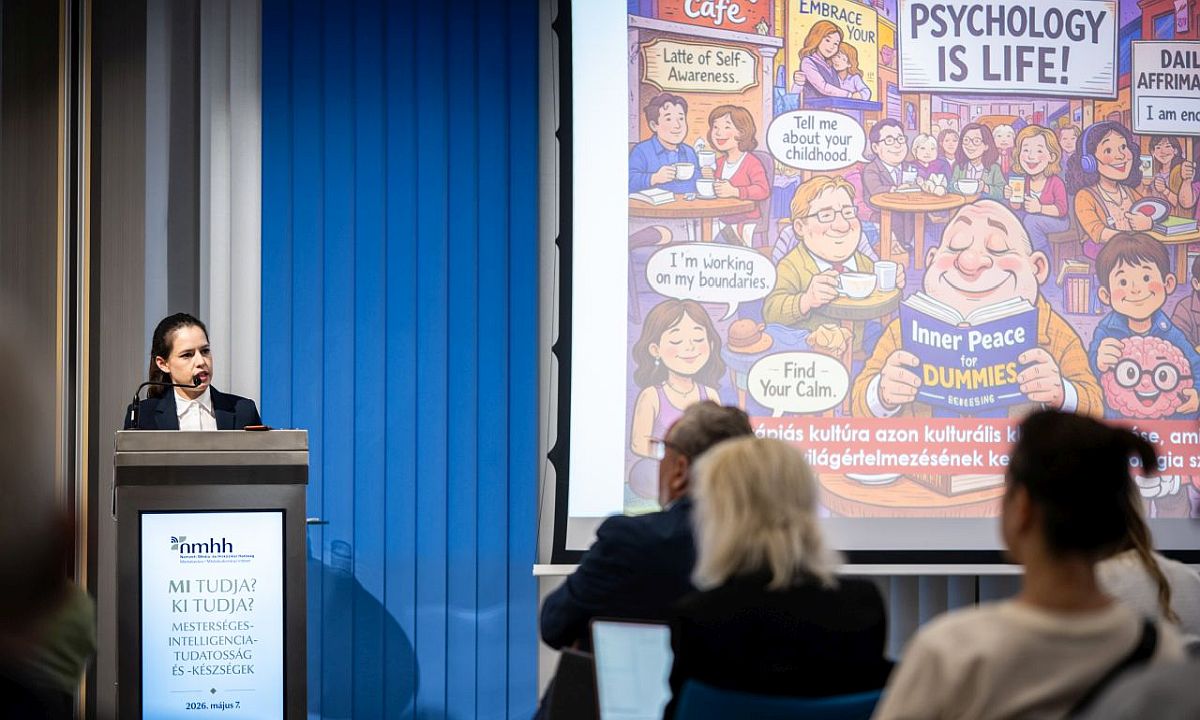
Multidisciplinary conference on child protection held in Győr
The joint conference organised by the Institute for Media Studies (MTMI) of the National Media and Infocommunications Authority (NMHH) and Széchenyi István University (SZE) focused on links between child protection and innovation, and the effects of technological, social and institutional changes on young people. The programme included presentations from representatives of fields such as health and sports sciences, psychology, education, sociology, law, and media studies.
The SZE Győr Innovation Park hosted the conference called “Child Protection and Innovation”, jointly organised by its Centre for AI and Future Strategies and the NMHH’s Institute for Media Studies. Experts at the forum explored how new technologies, as well as social and institutional changes, affect the lives of children and young people.
Professor Eszter Lukács, the university’s Vice-President for International Affairs and Strategic Relations, said that six counties in the Northern Transdanubia region have more than 220,000 primary and secondary school children, and therefore the university considers it an obvious responsibility to connect with young people even before they enter higher education. This is the purpose of, among other things, children’s universities, open houses for secondary school students, campus and lab tours, library and archive workshops, and career guidance programs launched jointly with Mobilis, Chinese language courses organised by the university’s Confucius Institute and the “Law-Conscious” lecture series. “These initiatives differ in both their themes and methods, but are united by the same idea: as a university, we feel a sense of responsibility for future generations”, she said. She added that the issue of child protection also fits into the context of this social engagement as social media, online platforms and artificial intelligence have created situations that previous generations did not have to face.

Levente Nyakas, Head of MTMI, recalled that they launched the annual child protection conference series in 2022. The event in Győr is the fifth edition and, in terms of the number of presentations, the largest to date, bringing together perspectives from the fields of law, communication, health and sports sciences, and education. The core idea of the series is that children’s media use can only be properly understood by drawing on findings from multidisciplinary results. “We are building a professional forum that connects scientific understanding with experiences in education and the work of authorities”, he emphasised. He added that the NMHH also supports children’s safe media use through Magic Valley Media Literacy Education Centres, the Internet Hotline, which helps address online abuse, and its publications for parents and educators.

The series of plenary presentations was opened by Professor Petra Aczél, Director of the university’s Center for AI and Future Strategies. In her view, we are living in an era that represents a turning point when it comes to media technologies fundamentally transforming everyday life and its ramifications are having a particularly strong impact on young people. She emphasised that what sets the Győr conference apart is its focus on linking scientific findings, innovations and practical developments. Participants also had the opportunity to meet with representatives from companies and initiatives that are developing solutions to help children, parents and educators. She added that bringing together businesses, researchers and academics can help ensure that viable innovations are put into practice as soon as possible.
Next, linguist and communication researcher Ágnes Veszelszki spoke about the effects of chatbots on language use, Levente Nyakas addressed regulatory issues surrounding young people’s access to social media and Professor Attila Szabó, a research professor at Széchenyi István University who ranks among the top 2 per cent of the world’s most cited researchers based on data from Stanford University and the Elsevier database, gave a presentation on the potential neuro-psychophysiological consequences of AI use on the developing brain. During the day, child and adolescent psychiatrist and psychotherapist Adrienn Németh explored the connections between mobbing and bullying, as well as adolescent anxiety, depression and suicide. Erzsébet Stephens-Sarlós, a researcher at the university’s Faculty of Health and Sports Sciences, spoke about the connection between primitive reflexes and screen-time effect.
In his presentation, Árpád Varga, Head of the Media Literacy Division at the NMHH, focused on the verifiability of children’s ages and the European Union’s draft legislation on Keeping Internet Digital Spaces Accountable and Trustworthy (EU KIDS Act). The presentation specifically addressed parenting competences, aspects of the proposal related to enhancing media literacy and children’s rights dilemmas associated with age verification. He discussed the sections of the NMHH’s study on digital parenthood covering parenting strategies, supporting the need to address age-related issues. As a conclusion to his remarks, he noted that a rational regulatory framework and appropriate educational strategies are needed to promote children’s safe participation in social media.

The conference also included a roundtable discussion on the challenges posed by artificial intelligence. Árpád Varga was joined by panellists Zsolt Ződi, a research professor at the Ludovika University of Public Service, and György Olivér Marchall, an expert at the National Cyber Security Institute. The discussion covered the impact of AI on children, dangers associated with overuse and the question of how to regulate this technology in the future.
Other topics in the programme included digital inclusion, media literacy, conflict resolution in schools and child protection issues in sports. In addition to the scientific presentations, the programme also featured poster presentations by PhD students and practical development workshops. Demonstrations also showcased the “Look At Me” signalling system to help make communication accessible for people with hearing impairment, several works by the university’s design students and more. The conference concluded with a roundtable discussion on the impact of artificial intelligence on children's lives.
-
 Lukács Eszter, a SZIE nemzetközi és stratégiai kapcsolatokért felelős elnökhelyettese
-
 Nyakas Levente, az MTMI vezetője
-
 Aczél Petra, a SZIE AI- és Jövőstratégiák Központjának vezetője
-
 Szabó Attila, a SZIE kutatóprofesszora
-
 A konferenciát az MI gyermekek életére gyakorolt hatásáról szóló kerekasztal-beszélgetés zárta
 Lukács Eszter, a SZIE nemzetközi és stratégiai kapcsolatokért felelős elnökhelyettese
 Szabó Attila, a SZIE kutatóprofesszora