Use of AI by authorities should be based on human oversight
Artificial intelligence (AI) can greatly enhance the efficiency of public authorities; however, human oversight remains essential to its use. This was one of the topics covered at the professional conference held by the National Media and Infocommunications Authority (NMHH), which also addressed the safe and lawful implementation of AI, as well as issues related to decision-making responsibility.

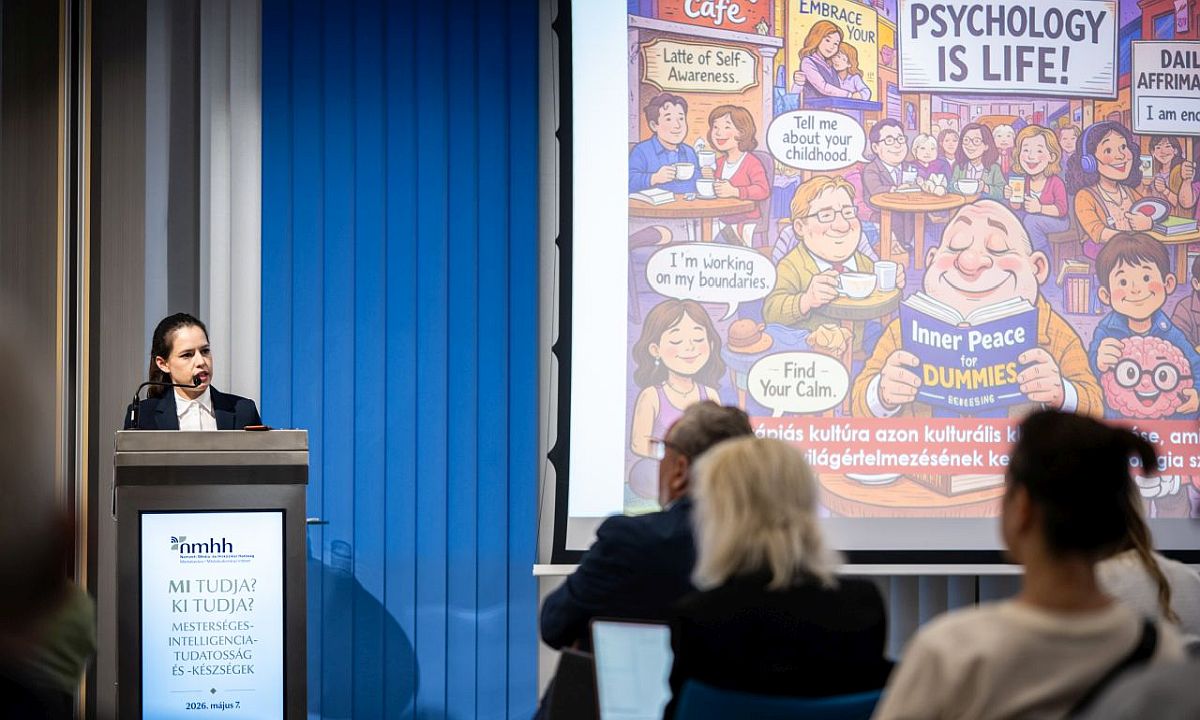
Janka Aranyosné Börcs, Director-General of the NMHH, welcomes conference participants
To kick off the event, the Director-General of the NMHH welcomed participants. Janka Aranyosné Börcs emphasised that we must see technology as an opportunity and that is why the authority must also explore how it can best leverage the benefits offered by AI.
One of the infocommunications experts at the NMHH provided an overview of the evolution of Artificial Intelligence from the work of Alan Turing to AI agents. According to István Bartolits, we are currently in the upper third of the era of Artificial Narrow Intelligence (ANI), while regulatory models in the EU, the US and China provide only a fragmented safety net. He believes that machines themselves could play a key role in the creation of an artificial superintelligence (ASI) that surpasses human intellect in every way.
Large language models are also capable of presenting fabricated facts with great confidence and references that seem credible, as pointed out by the Head of the Department of Telecommunications and Artificial Intelligence at BME. Pál Varga emphasised that even the most advanced models may “hallucinate”; therefore, it is essential to verify the information they provide.
The professional day revolved around the issue of who bears responsibility for decisions prepared or supported by AI. According to one of the experts at ENTEL Műszaki Fejlesztő Kft., the most important criterion in public administration is not the accuracy of the machine, but rather the verifiability of decisions, which includes justifiability, corrigibility and correctness. As Csaba Huszty put it, “using AI today takes courage; ignoring it tomorrow is negligence”.
AI also has the potential to fundamentally transform the defence industry. In this regard, an expert from the Hungarian Defence Forces General Staff compared the significance of the technology’s military application to the invention of fire or the wheel. Citing China’s advances in the development humanoid robots as an example, Colonel Zoltán Andi also pointed out that, in the long term, new types of largely automated military capabilities may emerge. Since Hungary’s general artificial intelligence strategy does not cover the defence industry, he believes the Hungarian Armed Forces must develop their own framework.
AI cannot replace human intelligence; however, by solving specific tasks, it can significantly support the work of authorities, as noted by the NMHH’s Deputy Director for Frequency and Identifier Management. Emília Ulelay reviewed the application of this technology in radio spectrum management, discussing the four risk levels outlined in the EU’s AI Act, the obligation to promote AI literacy, and transparency requirements.

Péter Hirling, Cybersecurity Officer at the NMHH
The implementation of AI is not an IT project, but rather involves organisational transformation that requires rules, responsibilities and training, as pointed out by the NMHH’s Cybersecurity Officer. According to Péter Hirling, instead of banning AI, conditions for its controlled use should be established, while the lack of “AI expertise” should be addressed through dedicated programs.
A professor from Széchenyi István University spoke about the role of AI in electronic communications and national security. Hedvig Szabó focused in particular on the regulation of dual-use technologies that serve both civilian and defence purposes, such as 5G, as well as on the rapidly changing regulatory environment.
As part of the educational section of the professional day, AI strategy consultant Gabriella Dalos-Kovács reviewed AI readiness, organizational maturity and the role of managerial oversight. Gergely Szertics, Director of the HUN-REN AI Service Centre, shared his experiences with the research network’s AI implementation programme, while Virág Balogh and Dávid András Köblös, experts at Magyar Telekom, presented their company’s practical solutions. They run an AI Governance Board that reviews use cases at a single point of entry, and they consider it as a tool to facilitate secure implementation, rather than a barrier.
AI may play an increasingly important role in recruitment, coaching and organisational development, as Irén Földesi pointed out in her presentation. The business coach also emphasised that the final decision should not be left to artificial intelligence in this area either. In his presentation, Csaba Huszty addressed another practical dilemma, the “build or buy” issue, that is, the choice between in-house development and readily available solutions, in the context of authorities.
Towards the end of the professional day, the NMHH’s in-house developments were given the spotlight. Klára Gutmann, Head of the authority’s Registration and Information Department, and Bálint Dienes, a technical analyst at the NMHH, presented the pilot for MIRA, a customer service MI assistant. The system generates draft responses to incoming customer enquiries, which are then reviewed and finalised by administrators. The in-house solution is based on open-weight models and a proprietary RAG system. Krisztián Bodzsár, Head of the NMHH’s Measurement Team, presented the results achieved in the field of radio frequency monitoring, noting that different models are required to detect anomalies in various radio services. Media literacy expert Veronika Pelle reviewed the challenges and societal risks of AI becoming a social actor, covering topics ranging from media literacy to human relationships.

István Bartolits, Infocommunications Expert at the NMHH
István Bartolits closed the professional day by stressing one of most important messages of the event: artificial intelligence can make the work of authorities faster and more efficient in an increasing number of areas, but its responsible use should still be based on verifiability, appropriate expertise and human oversight.
-
 Madarassy Dóra felelős szervező és Nyitray Ágnes protokoll munkatárs fogadja a látogatókat
-
 Bartolits István, az NMHH hírközlési szakértője
-
 Aranyosné Börcs Janka, az NMHH főigazgatója köszönti a konferencia résztvevőit
-
 Ulelay Emília, az NMHH frekvencia- és azonosítógazdálkodási igazgatóhelyettese
-
 Hirling Péter, az NMHH kiberbiztonsági felelőse
-
 Gutmann Klára, az NMHH nyilvántartási és tájékoztatási főosztályvezetője
-
 Dienes Bálint, az NMHH műszaki elemzője
-
 Bodzsár Krisztián, az NMHH mérési csoportvezetője
-
 Pelle Veronika, az NMHH médiatudatosság-szakértője
-
 Az előadássorozatot több neves szakember között figyelemmel kísérte Polyák Gábor, a Médiatanács elnöke, valamint Aranyosné Börcs Janka főigazgató
 Madarassy Dóra felelős szervező és Nyitray Ágnes protokoll munkatárs fogadja a látogatókat
 Ulelay Emília, az NMHH frekvencia- és azonosítógazdálkodási igazgatóhelyettese
 Gutmann Klára, az NMHH nyilvántartási és tájékoztatási főosztályvezetője
 Dienes Bálint, az NMHH műszaki elemzője
 Bodzsár Krisztián, az NMHH mérési csoportvezetője
 Pelle Veronika, az NMHH médiatudatosság-szakértője
 Az előadássorozatot több neves szakember között figyelemmel kísérte Polyák Gábor, a Médiatanács elnöke, valamint Aranyosné Börcs Janka főigazgató